Wednesday, 25 September 2013

Seamus Heaney at StAnza


A personal reminiscence by Brian Johnstone, former Director of Scotland's International Poetry Festival
 
Seamus Heaney at StAnza

In his funeral tribute to Seamus Heaney, Paul Muldoon talked about how everyone in the poetry community has been devastated by our sudden loss – how true – and this feeling extends well beyond the world of poetry. Muldoon went on to describe Seamus’s “signal ability to make each of us feel connected not only to him but to one another." So in this small remembrance of his connections to the StAnza Poetry Festival, and to me through my work for the festival, I simply have to address him as Seamus. To address him as Heaney seems too impersonal for such a generous and gregarious man. Although I only met him a few times, and attended no more than half a dozen of his appearances, my feelings tell me that I have lost a friend – a friend whose poetry has inspired me in my own writing, but also a man who made me feel he was a friend and supporter of all I tried to do with and beyond StAnza – someone who encouraged me in both of these endeavours whenever we met.
 
Seamus’s first appearance at StAnza was in 1999 – only our second festival, so we were aiming high even in those days. Through the support of St Andrews University School of English we were able, despite being a very young festival, to feature him on the bill. Seamus appeared on the Thursday night – National Poetry Day – taking the stage for a two part reading. In the first half he read from his various collections and in the second from his recently published translation of Beowulf. Needless to say, the event was wonderful and was very well received by a capacity audience.

I had actually first come across Seamus in performance at an event held as part of the Edinburgh Festival Fringe some years before. Watching the funeral online brought back powerful memories of this first experience since playing at various points during the church service was the uilleann piper Liam O’Flynn, with whom Seamus had performed at that Fringe event years back. Sitting side by side on the Assembly Rooms stage in front of a large audience doesn’t sound like the best way to achieve a close rapport with those listening, but so focused were the two that the experience was one of extreme intimacy. I felt as if I had been sitting at their fireside in rapt attention as poet and piper swapped verses and tunes. It was my first encounter with Seamus Heaney and it is one I will never forget.

It is this very sense of intimacy that Seamus was so adept at putting over to his audience, and which was characteristic of his subsequent appearances at StAnza. At that first one in St Andrews’ Buchanan Theatre, however, I only got to meet him very briefly because of his other commitments. I managed to shake him by the hand and thank him for his reading, and that was it. But this was enough for him to remember me when next we met, despite the hundreds of people he must have met in all his travels.
 
This occasion was in London at the British Library when I was representing StAnza at the 2005 launch of The Poetry Archive website. Seamus was the guest reader at this event and I was astonished to discover that he not only remembered me but was even happy to have a chat for ten minutes or so. We had bit of craic about the great Scottish poet – and mutual favourite – Norman MacCaig and I were able to personally invite Seamus back to St Andrews for a future festival. He was glad to accept, and we subsequently agreed on him topping the bill for the 10th festival in 2007. But I would be in his company again before then.

 
In the summer of 2006, Seamus gave a superb reading at the Edinburgh International Book Festival and I was fortunate to be invited to the reception held in his honour at the Irish Consulate. As always, Seamus was feted by a large crowd, but the reception gave me another chance to have a friendly chat with the poet and a welcome opportunity to meet his wife Marie. I remember him reiterating his real fondness for St Andrews – and for Scotland in general – and my saying how much we were looking forward to welcoming him back to StAnza the following March. Sadly, that was not to be.

I was on holiday in France later that summer when I had a call from home. It was my colleague Eleanor Livingstone, who was then StAnza’s Artistic Director, calling to let me know what had happened in my absence. The news was bad. Seamus had had a stroke and was in hospital. His doctors had advised him – ordered, more like – to cancel all engagements for the next year at least. All I could do was ask Eleanor to pass on my sympathies to Seamus’s family, with whom we were in touch through a mutual friend, and start thinking about who we could book as a replacement.

Back home, meeting Eleanor to discuss this, she told me about an extraordinary phone call she had received while I was still on holiday. If proof were needed – which it’s not – of Seamus’s extraordinary character, this is it. Having been unable to get any definite information, Eleanor had called the mobile number Seamus had given me for festival use. The following day Seamus, presumably having noticed her missed calls, phoned back. He was, he told her, still in hospital. But he was calling as he wanted to apologise to StAnza for letting us down!

Thankfully, Seamus recovered from that bout of ill health and by the next year was ready to discuss honouring his promise to come back to StAnza. While he explained that he wouldn’t be able to take part in the festival in the immediate future, he wanted to be clear – more generosity – that he hadn’t forgotten his promise. And so he was booked to appear in 2010, the last StAnza for which I was Festival Director. For me personally, this was a wonderful coup and for our audiences it meant that my stepping down would be marked with the biggest name possible. I was – am – so grateful to Seamus for that.
 
Working together on festival planning, Eleanor and I managed to programme not one but three separate events featuring Seamus. A full main stage reading in the Byre Theatre, of course; but we were particularly pleased that Seamus was also willing to give a round table reading, one of StAnza’s signature intimate readings for only a dozen or so people; on top of that, we arranged for him to take part in an In Conversation event with his friend and fellow Irish poet Dennis O’Driscoll (sadly also recently departed). A bumper appearance indeed!
I have a very special personal memento of my last festival as a director – and it is all down to Seamus. Naturally, I asked him to sign a few of his collections for me, one of these being my long-term favourite Station Island. The original Faber publication of this features on the cover and title page what looks like an illustration from an ancient Irish manuscript. This Seamus deftly altered adding speech bubbles to mark not just my departure from StAnza, but also my continuing commitment to the stanzas of my own poetry. It’s such a quirky and amusing bit of personal response. I will treasure it always.
Both the main stage reading and the In Conversation were sold out in record time and in the end we had to relay both events to the Byre Studio and Conference Room for overspill audiences. These Seamus surprised by dropping in on them unexpectedly during the interval so they at least had a brief personal encounter. Again, generous to a fault. Other visiting poets were crammed into every available corner of the theatre, just to ensure they caught the events. In the end, the audiences for both main events were at full capacity in the main theatre, and overflowing to not one but two additional venues. The audiences for both main events were well in excess of the actual capacity of their original venues!

But for me, the true highlight of Seamus’s last StAnza appearance was his round table reading. At that he surprised all present by producing photocopies of a series of new, unpublished poems and passing them round the table. These he proceeded to read for the audience and then – more astonishing yet – to more or less ask those present for a crit. We could scarcely believe that we were sitting round a table with someone of Seamus Heaney’s stature and he was asking us what we thought of his new work. Generous again, and inclusive in a way that, as Paul Muldoon said, made us all feel so connected to him and, through him, to each other.

There is little more I can say except that, while I owe the StAnza Festival so much, and through it have met numerous poets whose work I love and admire, being able to meet and share some small bits of time with Seamus Heaney is one of the things I feel absolutely the most grateful for. As the poet Jo Bell said so eloquently in her own tribute to Seamus, "Poetry stands for love. Those whom we remember are the ones who said most clearly, that which we are trying every day to say."

Author’s website: http://brianjohnstonepoet.co.uk/

Sunday, 22 September 2013

Get PENning


Linda Cracknell, a member of the editorial panel of PENning magazine welcomes submissions for the next issue on the theme of Masks. Deadline: 30th September. [Photo | Phil Horey]
 
Get PENning
Yes, it’s time to get your submissions in again! Do you have something appropriate in a drawer, in a past publication, or are you yearning to write something new? Your theme this time: Masks.
 
One of the pleasures of being on the editorial panel of our ‘PENning’ magazine is opening up the submissions to see how the current theme has been interpreted. Since it was launched in 2009, Home, Water, Stars, Journeys, and Steps have been amongst our themes. The magazine provides a showcase for writing by people who have come to live in Scotland from other parts of the world; not necessarily ‘writers’. Their poetry and prose appears alongside selected work from our members; professional writers. So the scope of literary, cultural and linguistic approaches is wide.
 
Many excellent submissions came winging in for last issue’s theme of Migration [link: http://www.scottishpen.org/new-writing/penning-migration ]. It was unsurprisingly resonant for writers from Scotland's immigrant communities. First Impressions by Meg de Amasi is a poem in two parts about an African nurse's arrival in Glasgow 'clutching her letter of invitation,/the only thing that said "I belong"'. The newcomer's first impressions are mixed but she remains quietly generous and open-hearted - a spirit which imbued several of the submissions under consideration. This was not the only time the panel, which included Stewart Conn [link: http://stewartconn.com/ ] as our guest editor, commented on the authenticity of the voice.
Unsurprisingly perhaps given the late Scottish spring, bird migration was a feature of several submissions. In Mandy Haggith's [link: http://mandyhaggith.worldforests.org/index.asp ] Immigrants she plays with the idea of birds as Viking marauders, wittily grappling with issues of avian immigration:
 
‘A horde of Viking birds
            descends
                         to pillage
                                      our rowan trees.
They squabble
             in foreign accents,
                                       feasting
                                                   and carousing.
Should we try to
             apprehend them?
                            You say
                                        'Send them back to Norway!'’
Each member’s submission was considered anonymously. So it seemed most appropriate that when the names were revealed, a poem by A C Clarke [link: http://www.poetrypf.co.uk/acclarkebiog.shtml ] was amongst those included in the final selection. Anne instigated PENning and her hard work made it what it is today. With her resignation from the editorial board she, like all Scottish PEN members, was free to submit her work. Her poem, Well, sheds light on the world of the refugee, '... a wanderer/ who may never pitch tent/ in the land of your fathers/ nor ever call a place/ truly home.'
And now we are anticipating the next submissions on the theme of ‘Masks’. Multiple identities; carnivals; concealment? I’m looking forward to seeing how it’s seen and penned. And if you have an idea for a great theme for a future issue, please let us know!
Please send in submissions by 30th September – you’ll find the guidelines here [link: http://www.scottishpen.org/new-writing/new-writing-submissions ].


Saturday, 21 September 2013

Hame-comin


Gerda Stevenson's entry - Hame-comin - to the YES Arts Festival Poetry Challenge was selected as the winning poem by judges Allan Massie, Rosemary Goring and Tom Murray. The challenge was to respond to the words The Flooers of the Forest, in Jean Elliot's great song of that title, which is about the Battle of Flodden, this being the 500th anniversary of that tragedy. Gerda's response was a contemporary (international) take on war, written in the Scots language, the flooers in her poem being the opium poppies of Afghanistan.


Hame-comin
 
Hame, hame, hame on the truck,
the wheels grind their grumly air,
hame tae ma mither, ma faither, ma lass,
but I canna come hame in ma hert nae mair,
noo that ma fieres are laid in the grund,
and the desert sun has blurred ma een,
stour in ma mind frae yon cramasie flooer
that smoors aa pain on field and street,
no, I canna, canna come hame in ma hert
noo I’ve duin whit I’ve duin
(orders are orders, ye dae whit ye maun),
and I’ve seen whit I’ve seen:
 
oh, the bluid that brak through her skin
like a flooer frae its bud, yon bairn
that cam runnin, birlin, lauchin, skirlin
intae the faimily dance o mirth               
we blew tae hell like a smirr o eldritch confetti;
 
and noo I’m here, hame on the truck,
ma fieres in the grund, but I canna come hame
nae mair in ma hert, for hame’s naewhaur
when yer hert’s deid – nae langer sair – juist deid
wi dule and the wecht o bluid fallin like flooers,
cramasie flooers, that kill aa pain, smoor yer mind,
deid, deid, as the wheels grind.
 

Thursday, 12 September 2013

Kosova, a very young Republic


Prizren, Kosova


In early 1999 NATO planes flew over Kosova, then still part of Serbia, dropping bombs on significant targets, to stop the Serbian military and paramilitaries from their destructive and intimidating assault on unarmed civilians, who had begun to leave their homes in huge numbers, refugees crossing borders into Macedonia, Albania, Montenegro, the countries neighbouring Kosova. By June that year, Serbian troops and tanks had retreated, NATO troops entered Pristina, and Kosovar refugees began to return to their homes, if they were still standing, or were rebuilding them if they were not.

In early 2000, when I was living in Albania, NATO’S KFOR troops still had a strong presence on both sides of the Sharr mountains which separate Kosova from Albania. The border was virtually closed, except for the military and senior UN personnel. Kosova was like a mythical land on the other side of the mountains. Not far away in terms of distance, but virtually inaccessible.

Several years later – 2013. Far from ideas of trying to smuggle myself across a border that's patrolled by the military, I arrive in Pristina by plane. I am even invited! I'm to read at the Drini Poetik Festival in the old town of Prizren. My flight was booked from Edinburgh via Istanbul, where I would stay overnight although 'night' was a little optimistic as I had to be up at 3 am. It was a somewhat circuitous route, true, but I had my invitation, my itinerary, and my tickets. But my memory of Kosovo as a near impenetrable, heavily guarded place had set in my mind, and throughout the journey I could not feel sure that I would ever really get there. And there were some delays, but when I finally stepped out of the plane onto the tarmac of Pristina's airport, it was into warm sunshine.

From the moment I arrived I was reminded of times spent in Albania, for although it is a different country, a very young country, this Republic of Kosova, these are Albanian people, share the same language of course, but also the characteristic Albanian energy, enthusiasm, hospitality, respect and truly remarkable generosity of spirit.

My hosts were Professors Shyqri Galica and Abdyl Kadolli, President and Vice-President of the Writers League, who met me at the airport. We drove through the green and lush countryside of Kosova, (there had been a lot of rain I was told) and the houses set in this green and undulating land all looked trim and neat, flowering gardens, green fields, orchards and vineyards, so I began to wonder if this was some part of Switzerland I'd arrived in. We drove along the recently built highway which links Pristina to Tirana in Albania. The road was impeccably smooth, and almost deserted. Prizren itself is surrounded by the Sharr mountains which separate Kosovo from Albania.

The Festival opened with an art exhibition, followed by various speeches which I cannot say I fully understood, my Albanian being extremely basic, but I got the gist of the fulsome welcome extended to everyone. Riza Lahi, a writer from Tirana, who speaks good English, was assigned to me as interpreter, a lively and friendly man, who was a former military pilot and interpreter.


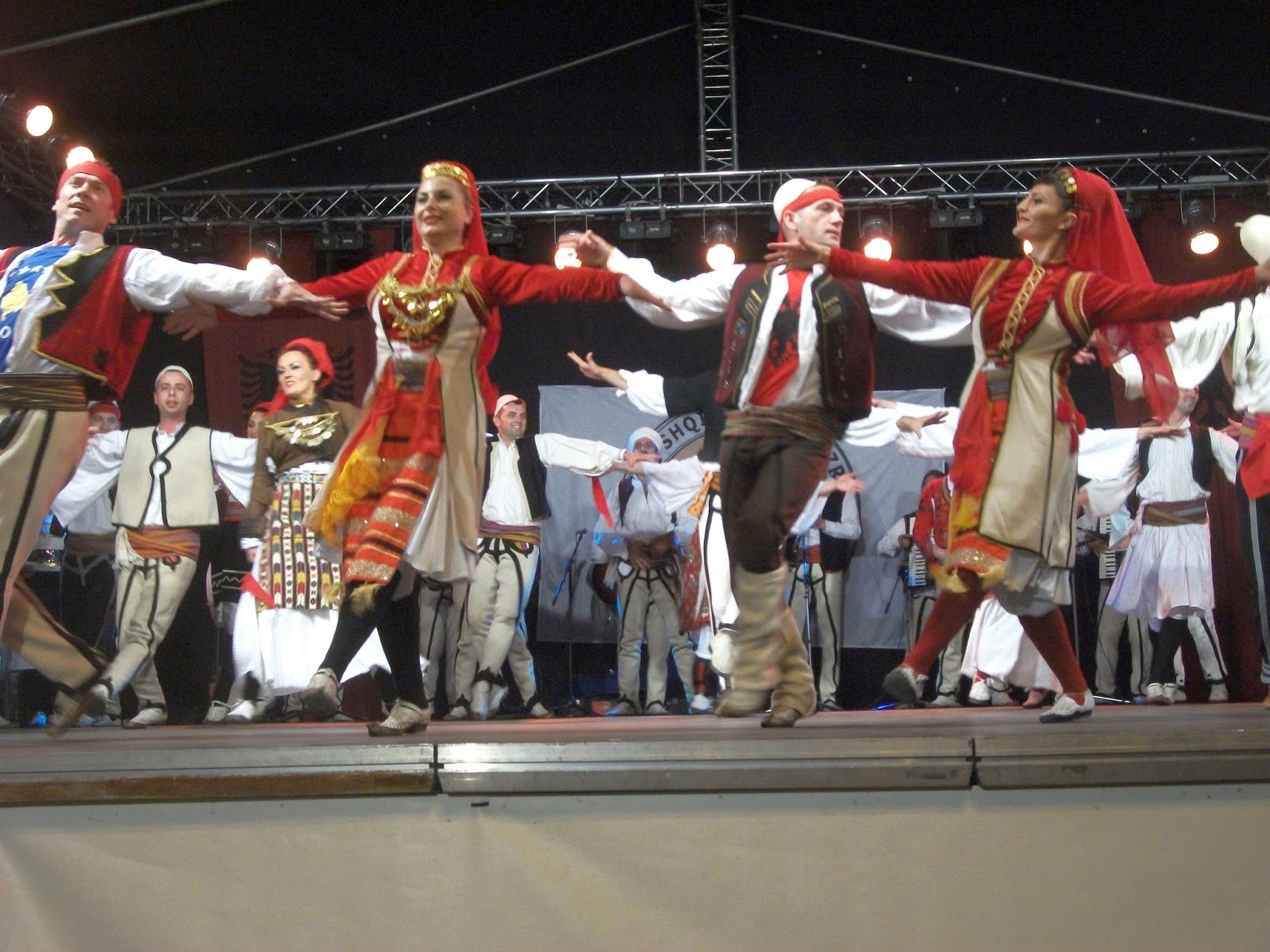
Traditional folk dancing, Prizren


After the speeches and talks on the theme of ‘The Author and Literary Publications’ we go to the outside café, and there I meet various other writers, including Arben, a young man who lost a leg while fighting for the Kosova Liberation Army. I ask him if he is happy now that Kosova is independent. Pa djeter (of course) he smiles. Arben tells me later that he never wanted to be a soldier, he was a writer, but during the war, when people were being killed, their homes shelled and burned, he felt he had to do something for his country, so he joined the KLA/UÇK and for 3 years lived and fought in the mountains around Prizren.

We are then driven outside the town to a restaurant surrounded by the green and forested Sharr mountains, by the side of the river Lum Bardhe. This wonderful meal went on for hours, before we were ferried back to Prizren for the evening readings, with musical interludes, fiddle and flute playing. I read in English while Shyqri read the Albanian translation, kindly provided by Agim Morina.

Outside in the warm night, there was a final coffee by the riverside, before I prevailed on my hosts that I had to sleep, and we headed back to the hotel. While I stumbled into bed, the Albanians stayed up talking and drinking for hours...

And that was just the first day. Of my first visit to Kosova. 

Morelle Smith 

Thursday, 14 March 2013

Simona Grazia Dima - PEN Romania

Simona Grazia Dima

SimonaGrazia Dima is Secretary of Romanian PEN, a poet, essayist, literary critic and translator. In her introduction to her latest volume of poetry she presents the background to her writing – the political and cultural milieu, her ideas, ideals and in particular the extraordinary experience which led her to become the writer that she is today.
I found it all inspiring – the relevance to our materially-obsessed times, the candour, perception and sensitivity. (Editor)


Simona-Grazia Dima
Foreword to The Army of Small Beings (Extracts)

The irrepressible need to talk about the hard nucleus of my poetry has been in my heart for a long time.

As I come from a family made up, in my maternal line, of a long chain of priests and hermits, whose roots can be traced back two hundred years, poverty and deprivations were not the hardest burdens on my soul during the dictatorship, although they were not easier for me to endure than it was for others; on the contrary, my health has suffered and is still suffering as a consequence of those conditions. I was born with a very sharp sensitivity and, in high-school and then at university, I was painfully affected by the impact of the social world on values, morality and culture. I saw wasted energies, and what was not being done for the isolated Romanian culture, not only abroad but also, primarily, inside the country – the lack of interest in a person’s true personality, the pastiche and simulacrum we were replaced with (and we still are! − when have we NOT been replaced!?), for the sake of (exclusively social) dogmas and the promotion of some writers who ‘had to be published’.

It was not until the post-revolutionary era that I fully understood how, beyond the particulars of political systems, much of what happened was also because of people; analysing things coolly, we must admit that nobody ever deterred us (neither the dictatorship, nor the system) from being good, just or generous, if we wanted to be, changing the given circumstances with our humanity; therefore, no big words, just a response appropriate for a particular situation. That is why viewing people exclusively as social entities seemed to me rather unproductive. The essence of the political world and that of social thinking revealed themselves to me as not necessarily harmful but merely reductionist and limited, drawing the individual according to the notions of success or failure, as an element on a scale which defined him from the outside. Excessive trust in these notions suggest we should accept as a life slogan the fact that man is only a dog raised with Pavlov’s reflex, a dog quickly coming for his meal, without knowing other legitimate coordinates. Should we blame only the lack of education, the atheism instilled with perseverance? However, man cannot be fully trained. Parents and tradition have also preserved many values. Human development does not take place according to some official coordinates but follows an inner course which is hard to describe or anticipate – a very personal course. So I have not stopped searching for other saving dimensions inside me.

*
However, as I did not have a clear training in the spiritual domain, I would suffer; I took to heart everything I thought was evil and ugly around me. I noticed that loud-mouthed, impertinent, persistent and insincere people were promoted, those that did not seek harmony and were ready to do anything for social advantage. And I was not wrong, (but this is going on now, at higher rates, with increased virulence, for the stake is greater and life’s rhythm is faster today). As I said, I felt that life had other implications than the social dimension, and I have always told myself that this intuition is true. Poetry was an example of a different intuitive success, a perception of some essential truths by means of gentleness, without traumas or outside pressures; by an innate knowledge, similar to Platonic knowledge.

*
I used to read biographies of artists (and I prefer this kind of reading even today). They paid for their independence or creative boldness with exile, marginalization or even death. In other cases, when they were not understood by their contemporaries, they paid with a momentary eclipse. Culture for me was never an insipid or futile activity or entity, consisting in sophisticated chatter, or in the cosiness of a salon or of a comfortable situation. Instead, it was the quintessence of life, a priceless human testament to be left to the descendants. It was an example to be at least contemplated, if not followed.

For me, reality (I mean true reality) was not to be found in the level of the concrete but in the world of principles, which was at the core of poetry, unlike prose - hence, perhaps, the impression of intellectualism or abstraction. I do not believe that the supreme indication of reality can be found in the torrent of daily events but rather in the force of consciousness, and the impact with what is imperishable. In this respect, poetry can be an urge and a living justification of a spiritual existence (even an actualization, just as, by sound, a song becomes immemorial), establishing, by its holy sovereignty, another beatific dimension, in which there is nothing to ignore, nothing to cast away, and nothing to blame. In poetry even the critique and the acid verb has something luminous, a bright halo, due to closeness to a generous Source. The hieratic quality of the icon does not mean dryness.

This introduction is only meant to sketch the atmosphere in which I began to write poems. ….

On the occasion of a national student event in Suceava, I was walking in the deserted former Throne Citadel, very upset about the helpless situation I felt my country was in (and I did not see the part I could play in the future either). The festival, or colloquium, seemed highly politicized, predictable and manipulated. And so it was. We, Romanians, made a mistake by not being, except to a small degree, open to the miraculous, expecting only the predictable and being satisfied with it. Actually, that was what made me despair the most.

Against this background, the perception of poetry – as I was saying, all areas seemed interwoven, trouble in one area immediately causing another trouble somewhere else, in a symmetrical plan – appeared to be glowing, living, comforting, and almost maternal. My eyes fixed on one of the abysses of the citadel (archaeology has always been a passion), I got caught in a vertigo and whirled about in an incredibly intense suffering, as if death was in front of my eyes and as if I was facing an absolute dead end. Then, all of a sudden, I felt a full resurrection, followed by an intimate, mental vision, perfectly clear, of a river of light – quiet, beatific, friendly and eternal. The entire world, wisdom, senses of the Universe and all my poetry were concentrated in that silvery bright river of thick honey. At that moment I had the certainty that under the layer of overwhelming reality there has always been a layer of eternal peace, of relaxation and friendship, and of perfectly natural humour and merriness, close to each other and merciful. There were only love, compassion and understanding of everything.

Since that moment I have found my full poetic inspiration and I have created the mythology of small beings – the ones I feel the urge to define further, in order to protect them from the vulgarization they may fall victims to (and sometimes have fallen victim to). The small beings are not some minor lives to be mistaken for things like flowers or small animals etc. (although I have often used such topics in my poetry), but they exist in the eternal creative layer, in the foundation inherent in the manifestation and in generic existence, and at this point they meet with Christ’s message or with the message of the Upanishads. As can be seen, I instantaneously reached the conclusion that there is a convergence of religions at a metaphysical level they have, which can allow – and cause, as a special feast – unity in diversity. If these beings are small it is because they are modest, and because they represent the lives hidden at the core of manifestation, determining the other level of the visible existence. They may be similar on the external, manifest level, to those humble people praised by Jesus in the Sermon on the Mount, but they are also to be feared, for they create the world; and, after it wears out, they destroy it. However, they only destroy its form, while the inward core of existence remains, however, eternal – resuscitated as a celebration of tireless existence. They seem to be various but they are like a monolithic existence, an ontological block which cannot be conceived separately − even though they can be separated into different existences. A sign of oxymoron, of paradox, that might be a possible description for them, accomplishable only through poetry – which is what I have been trying to do. So poetry played not only an aesthetic role for me but also an ontological role, enabling me to understand and live life by its highest coordinates, the spiritual coordinates. In an ideal mystique of the desert, I equated the desert with the desert of the era we live in and the analogy worked wonderfully. It is still working and will continue to work.

The poems literally flooded in cascades after that moment and they were included in a volume which was very difficult to have published. It was a consequence of that ideological era. The small creatures were rightly and wrongly considered subversive: rightly because they seemed to undermine the state order, like a sort of menacing Martians – which they were, actually – dissolving the barren conceptualization we have already talked about; wrongly because they are eternal, can be read at any time and in any place and, since they are invulnerable, cannot be attacked (and they are not maleficent either, because they are beatific). It was therefore sheer ingenuousness to reject them. But the censors did not know that. The system functioned with all its absurd machinery. Therefore, I published the volume after being excluded five times from the editorial plan (editorial production was planned in those years), but it was incomplete. It would have been too large and, besides, not all the poems were ‘suitable’.

*

I have emphasized the moment of epiphany in Suceava because I have previously only talked about it episodically and fragmentarily, and yet it is worth talking about, as my whole poetry has sprung from it. That moment unified the present and the past of my art as an essential core or a condensation of time, just as a seed encloses a tree in itself.


*

My concerns do not seem at all unusual to me in the context of contemporary Romanian poetry, and I wish them to be known more widely, as a dissemination of a rich experience which can bring joy to others. Of course, they refer to an alternative way of writing poetry now, at this moment, when perception is mainly focused on a ‘positivist’ view of life, in the sense of a gaze from/towards the outside. The obstinate search for interiority which characterises my poetry is not a minor or pointless thing to me, as it expresses a sincere aspiration to which I am devoted. I also believe that, in a normal society, it should not be necessary to continuously justify what we do. ….[And] poetry is never a dogma but a spark from the beauty which accompanies us, intact, forever.


Translated from the Romanian of Simona-Grazia Dima by Adriana-Ioana Nacu-Minculescu


Simona-Grazia Dima was born in Timisoara, in a family of writers. When 8 years old she won a prize for a theatrical sketch, Lica's Mask, which was staged by the Puppet Theatre in Timisoara, as well on tours throughout Romania and abroad. She graduated as a national valedictorian from the University of Timisoara, the Faculty of Philology. As a student, she was the president of the literary circle of the Students' University Centre in Timisoara. Simona-Grazia Dima is mainly a poet, but also an essayist, a literary critic and a translator.
She is an active contributor to the leading Romanian literary magazines and the author of ten books of poetry :Ecuaţie liniştită (Serene Equation),1985, Dimineţile gândului (Mornings of Thought), 1989, Scara lui Iacob (Jacob's Ladder), l995, Noaptea romană (Roman Night), 1997, Focul matematic (The Mathematical Fire), 1997, Confesor de tigri (A Tiger's Confessor), 1998, Ultimul etrusc (The Last Etruscan), 2002, Călătorii apocrife (Apocryphal Journeys), 2002, Dreptul rănii de a rămâne deschisă (The Right of the Wound to Be Left Gaping), 2003, La ora fulgerului (When Lightnings Start Flaring) She has published two books of essays and literary criticism and has translated from English Arthur Osborne's Ramana Maharshi and the Path of Self-Knowledge (2003, title of the Romanian version: Sri Ramana Maharshi sau calea Cunoaşterii Supreme).
Currently Simona-Grazia Dima manages an international literary project which is a part of the International PEN Organization’s activity (The Linguistic and Translation Rights Committee), by preparing an anthology of contemporary Romanian literature in both electronic and written form in English and Macedonian languages. She is a principal editor in the Romanian Academy and lives in Bucharest, the capital of Romania.


Thursday, 24 January 2013

Times Stephen Spender Translation Prize for Brian Holton


Many congratulations to Scottish PEN member Brian Holton whose translation of Du Fu's poem has been commended in the 2012 Times Stephen Spender Prize for poetry in translation. As far as we know it is the first time a major UK translation prize has given an award for work in Scots.

Below is the prizewinning translation and Brian's commentary. You can find out more about his poetry and translations on his website.


Spring Sun on the Watterside Clachan


i
Frae toun ti toun, fowk eident at the hairst;
frae bank ti bank, the Watter deep in spate.
Gin A cud see the lang miles o heiven an yirth,
A'd see but the turnin years o aa ma days.
Ma theikit ruif wis warth a pickle poems,
tho in ma hairt it wis Tír na nÓg A socht aye.
Cark an care they smoored the line o ma life –
whit a lang an wearie stravaig ti win here the nou!
ii
Frae hyneawa A cam ti the thrie westlan kinriks:
it wis sax year syne A snappert an fell doun here.
Fremt masel, A forgaither wi auld freins,
but it's burn an shaw that kittles up ma speirits.
That faur ben wi idleset, A'll thole ma dairnit duds,
an whan A gang about, A'll dree ma holie shuin.
Ma mairch fences, they're aathegither stentless,
for the Lang Watter an the lift abune are aa ma joy.
iii
The bamboo A plantit's insnorlt wi tender green,
the geans A sneddit back blushin like wee lassies;
ma hairt clear an cauld as the mune's stane gless,
A'm come to face the wund frae the snawy ben.
An ashet o siller they haunit this auld bodach,
a reid-tape dunderheid at did whit he wis tellt.
An wha'd hae thocht, whan ma teeth hed faan out,
ma name'd be doun i the Buke o Wyce Auld Men?
iv
Maugre ma maladies A hae a crammasy signet still,
but nou A'm hame ti dauner owre purpie crottle;
A'm ettlin at ma eild inben ma kintra yett,
me at wis blate afore the wisocks o the Secretariat.
The bricht leam o the sun twines about the swallas,
an leafs on the watter pairt for the pickie-maas;
whiles the neibours brings shell-puddocks an fishies,
an speir whit time will A can gang an see them.
v
Yin cantin gowk1 made mane at cateran bands,
the ither2 wis incaa'd ti Court, a mid-age man;
the tane begoud ti scrieve his Speil the Touer,
the tither, weill-infitten, gat glorie for Bogle Tales:
their haas hereawa is set doun in the Buke o Warthies,
their hie ingyne better-kent nor our Halie Hermits.
In anither season, A umbethocht me o thir twae –
i the sun o yin mair springtime, ma hairt is wae.

Translated from the classical Chinese by Brian Holton 1Wang Can (AD 177–217) 2Jia Yi (201–169BC)


Translation commentary


Du Fu uses New-Style regulated verse, a form of some complexity, which, through the impudence of his rule-breaking and the virtuosity of his craft, he raised from being a vehicle fit only for upper class occasional verse to a poetic form of suppleness and precision which is capable of expressing the strongest emotions and transmitting the most complex messages: the tone and level of achievement are comparable to a Shakespearean sonnet or a Beethoven quartet.

The metrical patterns are based on syllable pitch-contours, something neither Scots nor English can replicate; there is a rhyme in every couplet, which is not easily achievable in translation: I substitute a shifting pattern of alliteration and a series of half-rhymes, and for the rhythm, a stress-based line in the style of the ballad stanza, with a mid-line caesura.

One reason for using Scots is to bring home the essential strangeness of Du Fu to English readers: the distance between his Eighth Century Chinese and the modern language is similar to that between English and Scots. For Scots speakers, by using the Mither Tongue, language of home and family and friendship, I aim to bring out both the essential warmness and humanity and the deep sorrow of Du Fu's voice.

Du Fu was also an extremely erudite poet, who was famous for the breadth of his reading, his knowledge of history, and the obscure and recondite nature of his references: such allusions can have no force at all in translation, and in most cases can only be kept by doing violence to the text, so I have gently substituted western allusions where I can (eg Boreas for an allusion of equal antiquity). Du Fu can also juxtapose a startlingly conversational couplet with one in the most high-flown diction. What a joy he is to work with!

Brian Holton